---
id: "7602767e-1cd5-4218-82e6-8c2ad1ef6506"
title: "Never send a human to do a machine's job"
report_type: "initiation"
published_date: "2026-10-26"
source: "Homodeus Research"
source_url: "https://homodeus.one"
report_url: "https://homodeus.one/research/report/decidr-ai-industries-dai-ax-never-send-a-human-to-do-a-machine-s-job-initiation-coverage"
lead_analyst: "Wei Sim"
lead_analyst_email: "wei.sim@homodeus.one"
access: "full"
requires_payment: false
issuer_paid: true
html_access: "free-registration"
html_registration_required: true
company: "Decidr AI Industries Ltd"
ticker: "DAI.AX"
exchange: "ASX"
gics_industry_group: "Food, Beverage & Tobacco"
country: "Australia"
country_of_listing: "Australia"
theme: "Consumer Staples"
currency: "AUD"
price_at_report: 0.22
publication_date: "2026-10-26"
price_date: "2026-10-23"
market_cap_m: 81.6
shares_on_issue: 354909488
week_52_high: 0.9
week_52_low: 0.195
avg_daily_volume: 656244
valuation_target: 1.10
valuation_method: "DCF"
wacc_pct: 11.299000000000001
tgr_pct: 3
commissioned_by: "Decidr AI Industries Ltd"
isin: "AU0000386310"
markdown_url: "https://homodeus.one/api/reports/decidr-ai-industries-dai-ax-never-send-a-human-to-do-a-machine-s-job-initiation-coverage.md"
bot_friendly: true
keywords: "catalyst here, tech acquisition"
modified_date: "2026-11-24T21:36:23.800Z"
---
# Never send a human to do a machine's job
## Stock Information
| Metric | Value |
| --- | --- |
| Ticker | DAI.AX (ASX) |
| Price at Report | AUD 0.22 (2026-10-23) |
| Market Cap | AUD 81.6M |
| Shares on Issue | 354,909,488 |
| 52-Week High | AUD 0.9 |
| 52-Week Low | AUD 0.195 |
| Avg Daily Volume | 656,244 |
| Industry Group | Food, Beverage & Tobacco |
| Country of Listing | Australia |
**Decidr AI Industries Ltd (DAI.AX)** offers exposure to the infrastructure enabling enterprise AI adoption. Its opportunity is to convert organisational knowledge into recurring software deployments, then expand across customers’ workflows and commercial relationships. **We initiate with an A$1.10 valuation**.
## Key Highlights
- Decidr captures customers’ operational knowledge and uses it to deploy AI workflows, creating opportunities for recurring software revenue and expansion within each customer. DAI's ambitions extend beyond AI orchestration within an enterprise to becoming the common language of AI across firms.
- An enabling layer for enterprise AI. Decidr is building the orchestration layer of AI. The focus has been on picks and shovels. In our view orchestration is the critical layer which enables business execution of AI. This is forecast to grow at 46% CAGR between 2026-32, faster than other layers of the AI tech stack Fig ?.
- Proprietary AI infrastructure – not just another AI application. Enterprise AI requires codifying an enterprise's tacit knowledge into AI workflows. DAI's acquisitions of Sugarwork and Rumi.ai allow it to capture deliberate and ambient knowledge, creating a data lake of proprietary knowledge – the building blocks of its recurring AI revenue base Fig ?.
- Networked intelligence beyond the individual enterprise. In March DAI further expanded its architectural framework to that of the …. The graph provides a common agentic language for agents to communicate across enterprises, with the potential to enable coordinated execution across businesses Fig ?. If adoption generates additional paying deployments, higher customer spend and reusable workflows, Agentic Graph could help support the sustained growth underpinning our A$1.60-per-share upside scenario.
**Valuation and recommendation:** We initiate with an A$1.10 valuation based on a blended DCF and relative peer comparison.** **The key tests are conversion of US pilots into paying deployments, expansion of recurring software revenue and improving cash efficiency. Further funding may be required before breakeven.
- 
## Valuation
| Parameter | Value |
| --- | --- |
| Price Target | AUD 1.10 |
| Methodology | DCF |
| WACC | 11.299000000000001% |
| Terminal Growth Rate | 3% |
## Upcoming Catalysts
| Period | Event |
| --- | --- |
| Q4 FY'26 | Sovereign compute pilot live |
| FY 27 H1 | Knowledge Security Platform v1.0 shipped |
| FY 27 H1 | Provisional patents & published research |
| FY 27 H2 | First bolt-on acquisition closed |
| FY 27 H2 | ARR acceleration |
## The Long View
**Investment Thesis:** Decidr is an agentic AI software company. We are at the early stages of the agentic era which is forecast to see strong double-digit growth into 2030 and beyond. Since the commercialisation of its agentic AI business in late 2024 the company has shown 6 quarters of consistent q-q growth illustrating a strong track record of execution in its early stages. Recent acquisitions of Sugarwork and Rumi.ai broaden the company's current tech stack while providing a starting customer base and foothold to expand into the U.S. which they see as their key growth market going forward.
### Scenarios
| Scenario | Target | vs Current | Description |
| --- | --- | --- | --- |
| Upside | AUD 1.60 | | Upside scenario DCF using WACC of 11.3% and TGR of 3%. Estimates imply FY26-32e Annual Exit Rate (AER) CAGR of 55% (upper end of consensus industry growth outlook estimates which range from 43-50%) and FY32e terminal EBITDA margin of 20%. |
| Base Case | AUD 1.10 | | Blended valuation of DCF and relative comps vs. peer set of agentic AI tools, platforms and workflow automation solutions |
| Downside | AUD 0.20 | | Weaker than forecast growth and failure to achieve meaningful penetration into the US markets. |
**Sustainability Matters:** - Partner-channel revenue represented 54% of June AER, creating concentration and execution risk if partners fail to generate expected customer deployments.
- Successful integration of Decidr, Sugarwork and Rumi is essential to realise product synergies without disrupting development, customers or key personnel.
- Cybersecurity, privacy, data ownership, AI reliability and regulatory compliance are central sustainability matters because DAI targets regulated enterprises with sensitive operational knowledge.
- Edible Beauty remains a source of diversification but also strategic complexity, with June-quarter revenue down 15% year on year despite delivering a second consecutive profitable quarter.
**Catalysts:**
- Continued AER growth accompanied by stronger invoicing, cash collections and recurring revenue
- September 2026 quarter will begin incorporating new and growing Sugarwork contract revenue
- Delivery of the targeted $5 million annualised cost reduction
- Large US enterprise wins or reseller agreements under new Sugarwork CEO Andre Liao
- Customer wins generated through AWS Marketplace and the AWS ISV Accelerate co-sell channel
- Announced sovereign-AI customer deployments with SCX.ai, additional infrastructure partners or progress toward the planned 2027 fine-tuning product
# Executive Summary
## The missing layer
When discussing AI amongst business leaders, the views are common - everyone wants to use AI in the most effective way possible. The elephant in the room is how. **Decidr (ASX:DAI) **offers exposure to AI orchestration. This, in our view, is the missing and most valuable layer of enterprise AI. **AI orchestration **turns organisational knowledge into coordinated business execution. Over the next three to five years, the investment opportunity is that DAI has the potential to evolve from an early commercialisation business into an embedded software platform, generating recurring revenue across an expanding number of customers and workflows. Our A$1.10 base valuation recognises part of this opportunity. The A$1.60 upside scenario illustrates the potential value if stronger growth can be sustained alongside attractive software economics.

## Early mover advantage in the fastest growing layer
For most enterprises, the main challenge beyond access to capable models is making those models useful within the operating constraints of a business. Enterprises need systems that understand organisational context, coordinate tasks across applications and govern actions against business rules. Decidr’s Operating System ([DecidrOS](https://www.decidr.ai/product)) solves for this execution layer.
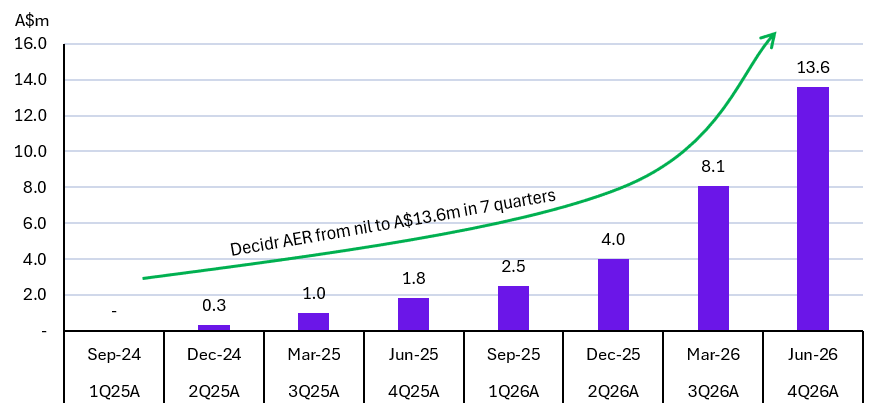
Decidr has an [early-mover advantage](https://en.wikipedia.org/wiki/First-mover_advantage) in the development of "the missing layer". Their … was established in September 2024, well before most enterprises had begun AI adoption. Since then DAI's annualised exit rate (AER) has seen exponential growth from nil in Sep-24 to over A$13m by Jun-26 Fig ?.

## The durable layer – AI infrastructure. Not another AI application.
Decidr's tech-stack is multi-faceted. Since the acquisition of Sugarwork (Jan-26) and Rumi.ai (Jun-26) Decidr now has an ecosystem capable of capturing both deliberate and ambient tacit knowledge, sovereign infrastructure for training and inference, and is in the process of building out its operational AI platform Fig ?.

Decidr's tech stack already provides a vertically integrated moat for creating the orchestration layer within a company. What will add durability is their next step. The …. Beyond building the agentic orchestration within an enterprise this is the AI infrastructure for agentic communication between enterprises – not just another AI application.

## Valuations
Our base case scenario values DAI at A$1.10/share. This assumes 46% FY26-32e CAGR in DAI's AER. Our base-case AER growth assumption is below the selected third-party market forecasts Fig ?, allowing for execution risk as Decidr develops its US business and recurring software offering. These forecasts put the agentic AI industry growth outlook at 43–50%, with a simple average of 46%. We have set our bull case forecasts for DAI's AER to grow at 55% between FY26-32e, which if achieved would value DAI at A$2.2 per share under our estimates.

**Upside catalysts:**
- US enterprise conversion and Sugarwork revenue: Delivery against the stated 1H FY27 pilot-conversion objective; disclosed Sugarwork revenue followed by integrated deployments and expansion
- Recurring revenue and retention: Progress toward forecast revenue of A$7.0m in FY27 and A$12.3m in FY28, with increasing subscriptions, renewals and customer expansion.
- Revenue converting into cash: A clear bridge from AER to invoicing, recognised revenue and receipts; receivables collected within contractual terms.
- Product delivery and deployment reuse: Knowledge Security Platform milestones followed by paying production use; shorter deployments and less bespoke engineering
- Partner and network conversion: Partner-sourced paying deployments, AWS channel conversions and active inter-company workflows with measurable outcomes
- Cost reset and funding efficiency: Verified A$5m annualised savings against a defined baseline, with burn consistent with the funding plan and improving delivery economics
**Downside risks:**
- Repeated pilot extensions, limited paid conversion or capture engagements that remain isolated
- Growth dominated by one-off work, weak renewals or little movement toward subscriptions
- Releases without adoption, prolonged integrations or delivery costs rising proportionately with customers
- Partnership announcements and graph coverage without commercial activity
## Decidr 101
**Decidr AI Industries (ASX:DAI) **is an agentic AI enablement group. Decidr.ai was founded by Paul Chan in 2018, and came to the ASX via the transformation of ASX-listed Live Verdure (ASX:LV1) following its staged acquisition of Decidr.ai over 2024-2025 (Fig ?).

Decidr helps companies become AI native using the framework approach in Fig ?. This is then combined with their enterprise agentic-AI platform that connects an organisation’s data, knowledge and workflows to automate business processes and support decision-making.
| Capture operational knowledge | Break workflows into executable tasks | Use the best model for the job | Keep customers in control |
| --- | --- | --- | --- |
| Most businesses run on decisions nobody documents. Decidr captures the tacit operational logic, exceptions, and workflows that normally live inside people's heads. | Complex work is translated into a series of smaller, deterministic actions that can be routed, audited, optimised, and repeated reliably. | Decidr routes every task to the most cost-effective and reliable executor, whether that's a FTE, a contractor, code, a more traditional AI model, or the latest and most advanced LLM, optimising cost and speed. | Businesses choose their own models, keep all of their own data, and maintain full control over governance and cost. No copying, no training, or unoptimised blanket solutions. |
The company serves customers across a broad range of sectors including Retail, Debt Recovery, Childcare, FMCG, Media, Finance and Healthcare (Fig ?).

### Rapid growth to be maintained
Decidr's life on the ASX only began in January 2024, and the company spent the first nine months implementing a …. By the quarter ended Sep-24 Decidr had recorded its first revenue and has since seen rapid q-q growth (Fig ?). Third-party industry forecasts for Decidr's industry growth range from 43% to 50% through 2030 and beyond.

### U.S. Growth engine; AU Core
To date Decidr's growth has been driven solely by their Australian business. In January 2026 DAI acquired 100% of Sugarwork Inc. and in June 2026 they acquired Rumi.ai (Rumi). Together, the acquisitions add customers and capabilities to its technology stack while providing a foothold for Decidr to expand into the U.S. market.
- Sugarwork (customer + tech acquisition): helps organisations identify where to focus their AI efforts by capturing operational and workflow knowledge from employees through structured interviews and generating detailed process documentation.
- Rumi (tech acquisition): adds a continuous, always-on capture layer to Decidr’s Knowledge Security platform. Rumi's two flagship products, X-Ray and Meeting Memory™, capture every conversation, connecting insights across meetings, in-person catchups, Slack, and CRMs, surfacing what matters most automatically and feeding it directly into customers’ proprietary reasoning graphs as live telemetry for sovereign model fine-tuning.
Following the acquisition of Rumi, Decidr is targeting the US as its growth engine and plans to direct a larger proportion of its commercial investment to the US over the coming 12 months. Sales and marketing will be US-weighted, although headcount will follow realised revenue. DAI is targeting the conversion of the first US enterprise pilot into a paying contract during 1H FY27, followed by a 2H FY27 revenue exit rate “materially above” the existing trajectory. Our current forecasts are more conservative than management milestones (Fig ?).

# Valuations and risks
## Valuation
We value DAI using a blended combination of DCF and relative comps multiples vs. peers. Our valuation for DAI is A$1.1/share (rounded) Fig ?
| Methodology | Weighting | Valuation | Assumptions |
| --- | --- | --- | --- |
| DCF | 50% | 1.20 | WACC of 11.3%, FY26-32e AER CAGR of 46% (mid-point of consensus industry growth) and FY32e terminal EBITDA margin of 20%. |
| Relative comps | 50% | 0.95 | Peer set of agentic AI tools, platforms and workflow automation solutions |
| Blended valuation: | | 1.07 | |
| Blended valuation (rounded): | 1.10 | |
### DCF valuation
Our base case DCF values DAI at A$1.2/share. Our base-case estimates assume DAI will see FY26-32e Annual Exit Rate (AER) CAGR of 46% and FY32e terminal EBITDA margin of 20%.
In our view, our DCF assumptions are reasonable if not conservative given the industry outlook. That said we do see potential execution risk on their US growth strategy given the nascent nature of the business.
The following tables illustrate the drivers of our WACC assumption, as well as our DCF sensitivity to changes in WACC and terminal EBITDA margin assumptions.
| | | | Current |
| --- | --- | --- | --- |
| Equity Beta | 1.36 |
| Risk-Free Rate | 4.50% |
| Market Risk Premium | 5.0% |
| Cost of Equity | 11.3% |
| Terminal Growth Rate | 3.0% |
| | |
| Cost of Debt | - |
| Debt/Capital | - |
| Tax | 21% |
| WACC | 11.3% |
Our base case DCF models FY26-32e AER (Annual Exit Rate) CAGR of 46%. We note that this growth rate is at the mid-range of industry consensus forecasts which range between 43%-50% till 2030 and beyond. Our upside scenario uses a 55% AER CAGR which is higher than industry outlook estimates.
| A$/shr | FY32e Terminal EBITDA margin | | A$/shr | FY32e Terminal EBITDA margin |
| --- | --- | --- | --- | --- |
| 16% | 18% | 20% | 22% | 24% | 16% | 18% | 20% | 22% | 24% |
| WACC | 9.0% | 1.75 | 1.91 | 2.06 | 2.22 | 2.38 | FY26-32e AER CAGR (%) | 35% | 0.28 | 0.35 | 0.41 | 0.48 | 0.55 |
| 10.0% | 1.35 | 1.48 | 1.61 | 1.74 | 1.87 | 40% | 0.57 | 0.65 | 0.73 | 0.81 | 0.90 |
| 11.3% | 0.98 | 1.09 | 1.20 | 1.30 | 1.41 | 46% | 0.98 | 1.09 | 1.20 | 1.30 | 1.41 |
| 12.0% | 0.83 | 0.93 | 1.03 | 1.12 | 1.22 | 50% | 1.31 | 1.44 | 1.56 | 1.69 | 1.81 |
| 13.0% | 0.66 | 0.75 | 0.83 | 0.91 | 1.00 | 55% | 1.79 | 1.94 | 2.09 | 2.25 | 2.40 |
| 14.0% | 0.53 | 0.60 | 0.67 | 0.75 | 0.82 | 60% | 2.35 | 2.54 | 2.72 | 2.90 | 3.09 |
### Relative comps
DAI is unique in the Australian market and has no direct comps in our view. Even in US listed markets, we see limited direct peers, the closest proxy being **Palantir (XNAS:PLTR).** Given the nascent nature of the industry, DAI's relevant comps are private. In Fig ? we have compiled a group of peers which, in our view, are the most relevant comps for Decidr and their implied valuations on EV/ARR and EV/sales based on latest transactions. The peer group set on EV/ARR is on average valued at ~24-34× EV/ARR and ~≥30× EV/sales.
| Company | Valuation ($m) | Valuation date | ARR / run rate ($m) | EV/ARR | Revenue ($m) | EV/sales | Company description |
| --- | --- | --- | --- | --- | --- | --- | --- |
| Abridge | 5,300 | 24-Jun-2025 | 117 | 45.3x | N/D | N/M | AI-enabled clinical documentation |
| Harvey | 15,500 | 09-Sep-2026 | >400 | 100 | 4,000 | 100 | 100 | 50 | 24.8x | Document intelligence; renamed SuperApp Inc., Aug-2026 |
| Writer | 1,900 | 12-Nov-2024 | N/D | N/M | >70 | 27.1x | Enterprise generative AI and agent platform |
| Sierra | 15,800 | 04-May-2026 | 200 | 79.0x | 100 E | 158.0x | Customer-facing AI agents across the customer lifecycle |
| AlphaSense | 7,500 | 03-Jun-2026 | >700 | ~10.7x | N/D | N/M | AI market research and intelligence |
| Median valuation / metric (x) | | 26.0x | | 36.0x | |
| Median excluding top two (x) | | 24.1x | | 27.1x | |
| Average valuation / metric (x) | | 34.2x | | 89.9x | |
| Average excluding top two (x) | | 26.2x | | 39.5x | |
DAI has yet to disclose ARR metrics, and given the strategy of their business model to build foundations of tacit knowledge through deliberate and ambient capture Fig ?, we think EV/sales is the appropriate valuation multiple for DAI over the medium-term.
| | Unit | FY27E | FY28E | Oct-26 |
| --- | --- | --- | --- | --- |
| | Jun-27 | Jun-28 | 1-yr fw |
| Forecast revenue | A$m | 7.01 | 12.27 | |
| | | | | |
| Implied market cap | | | | |
| Median excluding top two (27.1×) | A$m | 190.2 | 333.0 | |
| Median valuation / metric (36.0×) | A$m | 252.3 | 441.7 | |
| Average excluding top two (39.5×) | A$m | 276.8 | 484.5 | |
| Average valuation / metric (89.9×) | A$m | 630.4 | 1,103.5 | |
| | | | | |
| Implied valuation per share | | | | |
| Median excluding top two (27.1×) | A$ | 0.54 | 0.94 | 0.68 |
| Median valuation / metric (36.0×) | A$ | 0.72 | 1.25 | 0.91 |
| Average excluding top two (39.5×) | A$ | 0.79 | 1.37 | 0.99 |
| Average valuation / metric (89.9×) | A$ | 1.79 | 3.13 | 2.27 |
| Multiple implied valuation | | | | 0.95 |
### Multiple valuation vs. own history
We refer to multiples for context but see limited meaning in them and view them as poor proxies given the limited history and rapidly evolving outlook for DAI. That said, our valuations for DAI on revenue-based multiples are ~1 standard deviation below historical average and P/B is 0.4 standard deviations below its historical average, suggesting that compared to its own history DAI is looking attractively valued.

## Risks
- Near-term concentration risk could produce lumpy results. Partner channels supplied 54% of June AER, versus 32% direct enterprise and 14% foundation customers.
- Competition and supplier dependence. Microsoft, Google, Salesforce, ServiceNow, AWS and foundation-model providers could bundle competing agentic and orchestration functionality, which could compete with DAI's solutions.
- Acquisition and US-expansion risk. DAI's success depends partly on integrating Sugarwork and Rumi, retaining key staff, cross-selling DecidrOS and realising cost synergies. Future bolt-on acquisitions would add execution and dilution risk.
- Cybersecurity, privacy and autonomous-agent liability. Decidr is designed to ingest sensitive organisational knowledge and act across enterprise systems. Data breaches, hallucinations, incorrect autonomous actions or inadequate audit controls could produce customer losses, litigation, reputational damage and higher compliance costs.
# Industry Outlook
## AI vs. Agentic AI
**Artificial intelligence (AI) **is the technology that enables computers to "think", performing tasks such as recognising patterns, making predictions and generating content. Many AI applications respond to a specific input: a model forecasts demand from sales data, or a chatbot answers a question. The user or surrounding software then determines what happens next.
**Agentic AI **is an extension of AI that, beyond responding to an input, can also act upon it. An agent can use software tools, assess results and adjust its next steps within the boundaries defined by the user.
> In AI, the user determines what happens next; with agentic AI, the system can also act on an input.
For example, an AI assistant might draft a response to a customer complaint, while an agentic system could also retrieve the order, check the refund policy, initiate an authorised refund and update the customer record.
For businesses, this expands AI’s potential from assisting individual tasks to executing broader processes. The commercial value depends on reliable execution, integration with business systems and measurable productivity gains. Greater autonomy also increases the importance of access controls, monitoring and accountability, as errors can affect real transactions and records.
## What is a token (in the context of AI)
In the context of AI language models, a **token** is a unit of information that a model processes. For text, a token may represent a word, part of a word, punctuation or a space. A model breaks an input into tokens and generates its response as a sequence of output tokens. Tokens therefore provide a measure of how much information the model reads and produces. Many AI services charge based on token usage, while a model’s context window limits how many tokens it can handle at once.
These counts were calculated using the `cl100k_base`** tokenizer**. Other tokenizers may produce different counts.
| Sentence | Tokens |
| --- | --- |
| Hello, world! | 4 |
| The cat sat on the mat. | 7 |
| AI can help businesses save time. | 7 |
| Please summarise this report in three sentences. | 9 |
For example, **“Hello, world!”** breaks into four tokens:
`Hello` · `,` · `world` · `!`
The final sentence illustrates how a word can span multiple tokens: **“summarise”** splits into `summar` and `ise`. Punctuation also counts, while spaces are often included with the word that follows them.
A **crypto token**, by contrast, is a digital asset recorded on a blockchain. Depending on its design, it may represent value, access to a service, voting rights or ownership rights. Many crypto tokens can be transferred or traded, and their prices depend on factors such as demand, utility and speculation.
Although they share the same name, the two concepts serve different purposes: an AI token is a unit of information processing, while a crypto token is a digital asset. Paying for AI tokens generally means paying for computing usage; it does not mean acquiring an asset that can be held or resold.
## Open vs. Closed models
In the world of LLMs (large language models), there are two distinct types of models: open (also known as open-weight) models and closed (closed-weight) models.
- Open models are LLMs whose final trained parameters—the internal numbers that determine how it processes information and generates answers—are released publicly for anyone to download. Popular examples include Llama or DeepSeek.
- Closed models are proprietary systems where the creator keeps the source code, training data, and inner architecture hidden from the public. Popular examples include ChatGPT and Claude.
| Open | Closed |
| --- | --- |
| Full or partial transparency | High performance out of the box |
| Customization freedom | Managed infrastructure |
| Self-hosting capability | Enterprise-grade reliability |
| Community-driven innovation | Limited customization |
The following table compares the pros and cons of Open vs. Closed models.
| Attribute | Open | Closed |
| --- | --- | --- |
| Control and Customization | Can provide deep customization, domain-specific fine-tuning, or on-premise deployment | When customization needs are minimal and speed-to-market is critical |
| Cost Predictability and Scalability | Require infrastructure investment but offer predictable long-term costs. | Operate on usage-based pricing, which is excellent for pilots but expensive for high-volume use. |
| Data Privacy and Compliance | Allow full data control, critical for GDPR, HIPAA, and enterprise compliance. | Require trust in vendor policies, even when “data not stored” clauses exist. |
| Performance and Reliability | Performance gap is shrinking fast. Open-source models, when fine-tuned and optimized, now rival proprietary systems for domain-specific tasks. | Closed models currently lead in: General reasoning; Multimodal capabilities; Language fluency; and Continuous optimization. |
Inevitably, forward-thinking businesses are adopting a **hybrid AI stack**:
- Closed models for general-purpose intelligence and fast deployment
- Open-source models for core systems, sensitive data, and proprietary workflows.
It is in the latter category that **Decidr (ASX:DAI)**, through partnerships with companies such as **SCX.ai (ASX:SCX), **is building proprietary workflows based on the tacit knowledge of organisations which are kept within the organisation.
As shown in Fig ? open models’ share of usage across AI gateways that publish usage data has increased from an average of 15% of tokens in November to over 40% currently.

## Industry growth outlook
Decidr operates in the **enterprise agentic AI software industry**, specifically the market for **AI-agent platforms, multi-agent orchestration and autonomous business-workflow automation**. In our view, AI agents/agentic AI is a more precise addressable-market proxy than the broader artificial-intelligence, generative-AI or SaaS markets.
Third party estimates forecast growth in the agentic AI industry of between 43-50% CAGR between now and 2030 and beyond, as shown in Fig ?.

We forecast AER to grow at a 51% CAGR versus revenue at 70% over the coming five years. The slower growth in AER reflects the shift as one-off consulting revenues, which are larger but front-end weighted, give way to recurring revenues over the medium-term. The faster-than-industry revenue growth is driven by a combination of (1) a low starting base and (2) growth across two geographies (APAC and the US), also fuelled by M&A.

# About Decidr
**Decidr AI Industries (ASX: DAI) **is an Australian AI company developing DecidrOS, a platform designed to connect business data, coordinate AI agents and automate workflows across an organisation. The business started in 2018, when Paul Chan founded Decidr after building consumer research company **Pureprofile (ASX:PPL)**, which he established in 2000 and took public in 2015. Drawing from his experience analysing consumer profiles, Paul developed Decidr around the idea that businesses share certain common repeatable decision-making processes that could increasingly be automated through AI.
Decidr's connection to the ASX began through a collaboration with **Live Verdure (ASX:LV1) **in late 2023, initially developing technology for its existing businesses. Live Verdure subsequently increased its ownership of [Decidr.ai](http://Decidr.ai) to a controlling 51% in December 2024 and changed its name to Decidr AI Industries in March 2025, reflecting its shift towards commercialising AI technology.
| Time | Acquisition | Deal size | Target size when disclosed | What it does |
| --- | --- | --- | --- | --- |
| Nov-22 | Edible Beauty Australia | A$1m upfront: A$750k cash and A$250k shares, plus an earn-out equal to 10% of revenue for 24 months | FY22 revenue: A$2.2m | Direct-to-consumer and wholesale naturopathic skincare, supplements and wellness products. This predates Decidr’s AI strategy. ASX announcement |
| Dec-23 | Decidr.ai — initial investment | Initial 45% interest supported by A$2.5m initial funding, with up to A$10m contemplated; | Moving forward with the building of a go-to-market team and finalising appropriate platform functionality | Developer of DecidrOS, an agentic-AI operating and orchestration platform. It deploys AI agents across sales, CRM, search, content, recruitment, onboarding and other workflows. 49% acquisition terms, earlier stake details, operating scale |
| Dec-24 | Decidr.ai — controlling stake | 6% acquired for A$13.2m; | Quarter ended 30 September 2024: First revenue |
| Aug-25 | Decidr.ai — 100% ownership | Final 49% acquired for 78.4m DAI shares, worth approximately A$43.1m at the announcement-date share price | June 2025 annualised revenue: A$1.8m |
| Jan-26 | Sugarwork Inc. — 100% acquired | No cash valuation disclosed. Sugarwork shareholders received 4.13% of Decidr US. Decidr US also took on approximately US$0.4m of SAFE notes; a separate US$4m working-capital injection was planned | Eight personnel transferred; revenue not disclosed | New York enterprise-software company that captures undocumented institutional knowledge, maps real workflows and identifies automation opportunities. It supplies the structured organisational context used by DecidrOS. Original ASX deal, completion announcement |
| Jun-26 | Rumi.ai — completed during the June 2026 quarter | Undisclosed | Revenue, valuation and exact headcount not disclosed | San Diego AI meeting-intelligence platform. Its Meeting Memory and X-Ray products capture conversations across meetings, in-person discussions, Slack and CRMs, extracting decisions and reasoning for enterprise knowledge graphs and sovereign AI models. Decidr transaction announcement, completion update |
In January 2026 Decidr acquired ,… establishing an operational foothold in the United States; in June 2026, Decidr announced the acquisition of .… Both will complement the company's existing ….
## The Decidr Ecosystem
The following table illustrates Decidr's technology stack and how each component contributes to scaling value through a customer's lifetime from pilot.

### Sugarwork (Deliberate knowledge capture)
Founded in 2022 in the United States, Sugarwork ([www.sugarwork.com](http://www.sugarwork.com)) helps organisations identify where to focus their AI efforts by capturing operational and workflow knowledge from employees through structured interviews and generating detailed process documentation. Its platform enables enterprises to retain institutional knowledge, ensure operational continuity, and accelerate AI adoption by identifying high-impact areas for automation.
Sugarwork's customers include enterprise organisations like Supergoop, Appen and L-Cubed amongst other customers across finance, healthcare, industrial services, and professional services. Its technology solves one of the most persistent challenges in digital transformation - the inability of businesses to effectively capture and transfer critical operational expertise before automation.
Through the integration, Decidr's engineering resources will enable Sugarwork to accelerate product development and scale distribution. For Decidr, the acquisition provides access to well-defined workflows and organisational processes that can be orchestrated through DecidrOS, giving customers a seamless pathway from insight to execution.

### Rumi.ai (Ambient knowledge capture)
Founded in 2020, Rumi originated as Waitroom before evolving into an AI meeting intelligence platform. Its X-Ray and Meeting Memory products were designed to capture decisions, commitments and context across meetings, Slack and customer management systems, complementing Sugarwork’s structured interviews with continuous capture of everyday business (tacit) knowledge.
The Rumi team was integrated into Sugarwork to strengthen knowledge capture and support Decidr’s planned capability to train customer-owned AI models on proprietary organisational knowledge. Rumi’s standalone service was closed in July 2026.
### SCX.ai (Sovereign Model Training)
In May 2026 Decidr announced a partnership with [**SCX.ai**](http://SCX.ai)** (ASX:SCX)** for Sovereign Inference in Australia. Decidr also stated that in the U.S. they are in strategic dialogue with **Nebius (NASDAQ: NBIS)** via NVIDIA for scaled global inference with sovereign deployment. Decidr is also in discussions with multi-national hyperscalers on in-country deployments of DAI sovereign orchestration capabilities.
### DecidrOS (Operational & orchestrated AI platform)
**DecidrOS **platform enables businesses to build and deploy AI agents across functions such as sales, operations and customer service. "BetaOS” refers to its beta release/programme. DecidrOS differentiates from other agentic solutions in providing a platform rather than a fragmented set of AI tools. Every agentic app has a common language and governance model and runs on the same core logic. This means that everything runs according to the same metrics, and every action is aligned. This is the key difference between functional AI and orchestrated AI.
> DecidrOS differentiates from other agentic solutions in providing a platform rather than a fragmented set of AI tools. This is the key difference between functional AI and orchestrated AI.

Examples previously provided for a sales-driven workflow are illustrated below:
- Structure business knowledge: capture goals, definitions, processes and constraints in a shared blueprint—its “schema”.
- Execute workflows: use AI apps to collect prospects, qualify leads, personalise outreach and generate proposals.
- Control execution: apply permissions, decision rules, audit trails and human escalation.
- Track outcomes: give teams visibility into decisions and performance, with feedback informing subsequent work.
A case study of the above workflow is provided through the company's AVA … with Edible Beauty, along with metrics illustrating ROI.
Different industries will require variations to this workflow, thus an ecosystem of orchestrated apps is being created to address different business needs. The key is that they are all orchestrated to achieve the unified goal. The referenced figure Fig ? provides a more generalised framework as to how DecidrOS is being constructed based on the needs of each industry.
| Capture operational knowledge | Break workflows into executable tasks | Use the best model for the job | Keep customers in control |
| --- | --- | --- | --- |
| Most businesses run on decisions nobody documents. Decidr captures the tacit operational logic, exceptions, and workflows that normally live inside people's heads. | Complex work is translated into a series of smaller, deterministic actions that can be routed, audited, optimised, and repeated reliably. | Decidr routes every task to the most cost-effective and reliable executor, whether that's a FTE, a contractor, code, a more traditional AI model, or the latest and most advanced LLM, optimising cost and speed. | Businesses choose their own models, keep all of their own data, and maintain full control over governance and cost. No copying, no training, or unoptimised blanket solutions. |
## Proof of Concept
Ava is the customer-facing sales agent within Decidr’s broader Edible Beauty proof of concept.

It used the retailer’s product and business data to provide personalised skincare advice, recommend products, capture customer details and support purchases around the clock. The wider trial also covered appointment booking, marketing content, repeat-purchase campaigns and inventory recommendations.
| Timeline | Stage | Scope | Practical implementation |
| --- | --- | --- | --- |
| June 2024 | Stage 1 | Scoping, knowledge task capture, and workflow selection | Understanding Edible Beauty’s business processes, capturing the knowledge behind those tasks and selecting workflows suitable for AI deployment. |
| July 2024 | Stage 2 | Implementation of initial AI workflows and outputs | Connecting business data, deploying AI agents into live operations and progressively increasing their share of tasks based on customer feedback. |
| September 2024 | | POC completed | Moved Edible Beauty into commercial production |
| October 2024 | | Broader commercial launch | Customers were onboarded immediately after this launch |
| March 2025 | | Scale | Deployed contracts representing A$1 million in annualised revenue |
In August 2024 Ava reached 100% of website traffic, approximately four weeks after launch. The company reported over 25,000 visitor interactions with Ava available during the first month of full deployment. Initial results versus the preceding 12-month human-operated chat baseline showed 34% higher visit-to-chat conversion, 74% greater email capture, 52% more chat-initiated orders and 18% higher chat-to-order conversion, as shown in Fig ?.

In November 2024 updated comparisons with human-managed chat showed 131% more orders, 37% greater email capture and 6% higher average order value, indicating continued improvement after the initial trial. In March 2025 improvements to Ava’s visibility and onboarding reportedly increased Ava-driven orders 243% within a month. June reporting also cited a 39% session-to-order conversion rate, almost nine times the site average.
## Non-core business (Edible Beauty)
The remaining non-core operating business Decidr has is Edible Beauty Australia, the skincare and wellness brand. DAI's other non-core business 13Seeds was sold in July 2025 for A$65,000.
Edible Beauty remains owned and operating. DAI’s latest reporting shows it as a separate beauty/functional-food segment, while Decidr’s AI annualised exit rate (AER) explicitly excludes Edible Beauty. In our view, Edible Beauty is non-core and is likely to be divested over the medium-term. As such we have attributed no revenue contribution to Edible Beauty beyond FY26. We have also conservatively assumed no consideration for the sale of the business in our current estimates.

# Sugarwork
Sugarwork will be the initial driver of Decidr's near-term revenues as DAI assists companies to map out their workflows. Fig ? is an illustrative example of how we estimate the revenue mix from Sugarwork vs. DecidrOS to evolve over time.

### Unit economics
The following provides a unit economics breakdown of Sugarwork. We estimate Sugarwork’s initial contract value to be ~A$75–100k per customer. Sugarwork has not publicly stated its customer numbers, but based on disclosed logos, we estimate that its customer count at the end of CY26 will be ~20. Fig ? illustrates our estimated customer growth

Fig ? illustrates forecast EBITDA projections under each scenario assuming the low end of customer-number projections with the lowest ACV, and the high end of customer-number projections with the highest ACV, respectively.

### Implied TAM
Tacit knowledge capture is a distinct market from agentic AI transformation (Decidr OS). Capturing and structuring institutional knowledge is a prerequisite before that knowledge can be used by AI agents.

### Valuation scenario analysis
Our unit economics are likely to be conservative given the limited competition landscape and implied TAM on a top-down basis. We have deliberately kept them this way as execution is still at an early stage. However, as confidence in the company's growth builds we see upside risk to materially higher TAM penetration in both US and APAC markets. Fig ? illustrates the potential valuation for Sugarwork as a standalone business assuming various levels of TAM market share. Our valuation scenario analysis does NOT include the value of DecidrOS, which would be in addition to this.
| A$/shr | US market share |
| --- | --- |
| 0.08% | 0.1% | 0.2% | 0.3% | 0.4% | 0.5% |
| APAC market share | 0.05% | 0.26 | 0.35 | 0.74 | 1.13 | 1.52 | 1.91 |
| 0.1% | 0.39 | 0.47 | 0.86 | 1.25 | 1.64 | 2.03 |
| 0.2% | 0.65 | 0.73 | 1.12 | 1.51 | 1.90 | 2.29 |
| 0.3% | 0.90 | 0.98 | 1.37 | 1.76 | 2.15 | 2.55 |
| 0.4% | 1.16 | 1.24 | 1.63 | 2.02 | 2.41 | 2.80 |
| 0.5% | 1.42 | 1.50 | 1.89 | 2.28 | 2.67 | 3.06 |
# Decidr Agentic Graph
In March 2026 DAI introduced an update on the architectural framework underpinning its agentic systems strategy called the [Decidr Agentic Graph](https://www.decidr.ai/us/blog/what-is-the-decidr-agentic-graph). At its core, the [Decidr Agentic Graph](https://www.decidr.ai/us/blog/what-is-the-decidr-agentic-graph) is a live map of businesses and the commercial relationships between them, and an AI layer that acts across those relationships automatically. The Agentic Graph is the extension of DecidrOS beyond an individual company's AI orchestration to that of its associated businesses and is the Networked Intelligence of Fig ?.
Similar to how the internet revolutionised computing, we are all currently experiencing the power of AI for contained tasks to improve our individual workflow such as sorting through emails or summarising documents. This is akin to computers before the internet. Similar to the evolution of computers (or even humans for that matter), the true power of AI is yet to come, when agents **orchestrate **to work together rather than as individuals. **This is the Decidr Agentic Graph.**
> As AI use evolves we think AI value will migrate from “the smartest model” to "control of how AI decisions are coordinated, governed and executed". This is the future for which the Decidr Agentic Graph is preparing.

##
## Agentic Graph in Action
Decidr created a [video introducing the agentic graph](https://decidrindustries.ai/activity-updates/exJ2mP-dai-chairman-introduces-the-agentic-graph) which included an example (starting at 20:02) of the agentic graph in action. The following summarises some of the key takeaways from the agentic graph in action.
- Decidr preloaded 85,000 real businesses from Singapore into this graph (Fig ?).
- Each one is an agentic organisation, a structured digital twin encoding the entity's relationships, decision logic, and commercial context into executable schema (Fig ?).
- You can see prospects, customers, and as the network is expanded, DAI's system has identified both existing and prospective interlinking relationships across these organisations (Fig ?).
- Relationships between companies and prospects are inferred through orchestration via the compounding intelligence of the network itself - not manually mapped (Fig ?)
- For a company on DecidrOS, proposals can be automatically generated for every qualified prospect. These proposals are deep-linked, encoding commercial metrics, conversion signals, and value alignment specific to each counterparty.

At the broader level, Decidr has now mapped Singapore and Australia and is working through America, identifying every unique task within a sovereign economy, scoring each for AI suitability and pricing the replacement opportunity.
## Enterprise scale token economics
The Agentic Graph is an example of enterprise scale AI, but as AI scales from task to company, to enterprise, inference costs compound. Token costs grow exponentially as workflows link, because every additional step needs the context of every prior step. Decidr tackles this problem on two fronts:
- Tokenmaxxing vs. Tokenminning: Using the right model at the right time rather than frontier models for all tasks will reduce inference costs to what is most fit for purpose.
- Schema-governed workflows: having models operate against defined entities (i.e. guardrails), rather than open-ended prompts, dramatically reduces hallucinations and, again, the inference required.
# Financial Outlook
We forecast Decidr’s revenue to grow at a 54% CAGR from FY26A to FY32E. This is ahead of industry growth forecasts of 43-50% CAGR. We think this is justified from the low base from which Decidr is starting as well as their strategy to grow across multiple geographies.

Historical GP margin has been volatile, and is not a good indicator of future growth as it primarily relates to the company's legacy beauty, functional food & nutraceuticals business. We forecast margins to increase over time as the revenue mix shifts towards a greater recurring contribution from DecidrOS.

We forecast Decidr to reach EBITDA breakeven around FY31. The company has committed to an A$5m cost-out program to be implemented in FY27, but FY27 will also have the full-year cost contribution from the Sugarwork and Rumi.ai acquisitions.

# Board & Management
DAI has a lean board and KMP structure. Decidr's Board & Management have limited tenure at DAI. This is due to the company's recent strategic shift away from Live Verdure's direction in 2024. That said the newly appointed members all have strong relevant backgrounds in ASX listed companies, technology companies and scaling of early-stage and VC companies.
| Name | Title | Male / Female | Tenure (years) | Bio |
| --- | --- | --- | --- | --- |
| David Brudenell | Executive Chairman | M | 2.5 | David’s 20 years of international executive roles have included start-up-to-IPO (ASX:PPL), venture capital, large private and public market companies, Eclipx (ASX:FPR) and Appen (ASX:APX). David’s recent technology experience also extends into Artificial Intelligence, where he led the Global Solutions & Advanced Research teams at Appen, the largest provider of training data for AI/ML globally. This team worked at the frontier of generative AI and machine learning for the largest global technology company and federal agencies. He also serves as an advisor for several US-based Artificial Intelligence and Consumer Companies. |
| Adrian Bunter | Non-Executive Director | M | 2.5 | He is currently a partner at Modus Partners Australia, a boutique specialist technology, media and commerce financial advisory firm. Adrian is an experienced professional advisor, and non-executive director with 25 years’ experience. Adrian is also on the board of and advises several high growth, technology businesses, ranging from early-stage pre-revenue companies through to early-stage ASX listed companies Carly Holdings Limited (ASX:CL8) and 8Common Limited (ASX:8CO) through to larger high growth businesses, like ezyCollect and Australian unicorn, Employment Hero. Adrian is also a member of the Executive Committee of one of Australia’s leading angel investing groups, Sydney Angels. |
| Jenny Fielding | Non-Executive Director | F | 2.1 | Jenny Fielding brings a wealth of experience, with a background that spans law, finance, technology and investment. After graduating from law school and working in finance, Jenny transitioned to technology as a founder of two mobile software companies. This experience fuelled her passion for technology and innovation, leading her to a prominent career as an early-stage investor. Jenny is also an adjunct professor at Columbia University and Cornell Tech. For 7.5 years, Jenny was the Managing Director at Techstars, where she led investments into companies that now have a market cap of over USD $10B. She then co-founded Everywhere Ventures, a global venture capital firm. Jenny has been the first investor in over 250 tech-enabled companies, including five companies achieving unicorn (USD$1B+) valuations. |
| Name | Title | Male / Female | Tenure (years) | Bio |
| --- | --- | --- | --- | --- |
| David Brudenell | Executive Chairman | M | 2.5 | David’s 20 years of international executive roles have included start-up-to-IPO (ASX:PPL), venture capital, large private and public market companies, Eclipx (ASX:FPR) and Appen (ASX:APX). David’s recent technology experience also extends into Artificial Intelligence, where he led the Global Solutions & Advanced Research teams at Appen, the largest provider of training data for AI/ML globally. This team worked at the frontier of generative AI and machine learning for the largest global technology company and federal agencies. He also serves as an advisor for several US-based Artificial Intelligence and Consumer Companies. |
| Penny Diamantakiou | Chief Financial Officer | F | 0.3 | Penny brings 20+ years of senior finance leadership across ASX-listed, PE-backed, and globally listed companies. She has a strong track record in high-growth technology and SaaS businesses including Nearmap, WooliesX, Yahoo7!, and SingTel-Optus. Penny joined at a pivotal moment in DAI's global growth trajectory, bringing the financial leadership and commercial discipline required to scale DecidrOS across enterprise markets. |
According to the latest annual report (FY25) the executive remuneration and reward framework has four components:
- base pay and non-monetary benefits;
- short-term performance incentives;
- long-term incentives; and
- other remuneration such as superannuation and long service leave.
| Incentive | Structure | Hurdles |
| --- | --- | --- |
| short-term incentives ('STI') | annual targets and key performance indicators ('KPIs') being achieved. | KPIs include profit contribution, customer satisfaction, leadership contribution and product |
| long-term incentives ('LTI') | include long service leave and share-based payments. | Shares are awarded to executives over a period of three to five years based on long-term incentive measures. These measures focus on increasing shareholder value through share-price appreciation. |
# Appendix
| Organisation | Relationship with Decidr |
| --- | --- |
| CareerOne | Commercial recruitment partnership; Decidr-powered products generate recurring revenue through candidate–employer matching. |
| Edible Beauty | Direct deployment of Decidr’s AI sales consultant, “Ava,” across its ecommerce operations. |
| 13 Seeds | Decidr technology was embedded into the business when it was owned by DAI; subsequently sold by DAI in July 2025. |
| Australian Institute of Management / Scentia Australia | Two-year recurring-revenue contract covering AI tools for students, lecturers, enrolment and administration. |
| The Growth Faculty | Commercial AI Mentor product, with subscription revenue shared through the partnership. |
| ELMO Software | Decidr applications integrated into ELMO’s HRIS and employee-onboarding environment; initially launched through beta customers. |
| Onside Content | Described by Decidr as its first US-based customer; uses Decidr for personalised content generation. |
| Mercha | DecidrOS customer and published case study; uses Decidr across operations, including automated proposal generation. |
| eBev | DecidrOS deployment supporting procurement, forecasting, stock ordering and supplier matching for eBev’s hospitality network. |
## Financial Tearsheet
| Decidr AI Industries (ASX:DAI) | | | | | | | | Valuation: | | A$1.10 | | | |
| --- | --- | --- | --- | --- | --- | --- | --- | --- | --- | --- | --- | --- | --- |
| **Interim ** | **Unit** | **1H26A** | **2H26A** | **1H27E** | **2H27E** | | | **Full year ** | **Unit** | **FY26A** | **FY27E** | **FY28E** | **FY29E** |
| | | | | | | | | | | | | | |
| **Revenue** | **A$m** | **1.8** | **2.9** | **3.2** | **3.8** | | | **Revenue** | **A$m** | **4.7** | **7.0** | **12.3** | **20.1** |
| Cost of sales | A$m | -0.7 | -1.9 | -1.8 | -2.1 | | | Cost of sales | A$m | -2.6 | -3.9 | -5.8 | -7.6 |
| **Gross profit** | **A$m** | **1.1** | **1.0** | **1.4** | **1.7** | | | **Gross profit** | **A$m** | **2.1** | **3.1** | **6.4** | **12.5** |
| | | | | | | | | | | | | | |
| Cash OPEX | A$m | -10.4 | -15.2 | -12.4 | -13.5 | | | Cash OPEX | A$m | -25.6 | -25.8 | -26.8 | -27.8 |
| **EBITDA** | **A$m** | **-9.3** | **-14.2** | **-10.9** | **-11.7** | | | **EBITDA** | **A$m** | **-23.5** | **-22.7** | **-20.3** | **-15.3** |
| **EBITDA (incl-SBC)** | **A$m** | **-11.1** | **-15.0** | **-12.5** | **-12.3** | | | **EBITDA (incl-SBC)** | **A$m** | **-26.1** | **-24.8** | **-22.8** | **-18.3** |
| | | | | | | | | | | | | | |
| EBIT | A$m | -17.1 | -18.3 | -18.5 | -15.6 | | | EBIT | A$m | -35.4 | -34.1 | -32.2 | -27.6 |
| Profit/(Loss) before tax | A$m | -17.2 | -16.1 | -18.5 | -15.8 | | | Profit/(Loss) before tax | A$m | -33.3 | -34.3 | -32.7 | -28.1 |
| NPAT/(NLAT) | A$m | -17.2 | -16.1 | -18.5 | -15.8 | | | NPAT/(NLAT) | A$m | -33.3 | -34.3 | -32.7 | -28.1 |
| | | | | | | | | | | | | | |
| **EPS -Basic** | **A$** | **-0.07** | **-0.04** | **-0.05** | **-0.04** | | | **EPS -Basic** | **A$** | **-0.12** | **-0.09** | **-0.08** | **-0.07** |
| | | | | | | | | | | | | | |
| **Key metrics** | **Unit** | **FY26A** | **FY27E** | **FY28E** | **FY29E** | | | **Cashflow Analysis** | **Unit** | **FY26A** | **FY27E** | **FY28E** | **FY29E** |
| Annualised Exit Rate | A$m | 13.6 | 21.5 | 32.5 | 45.8 | | | Receipts from customers | A$m | 4 | 6 | 10 | 17 |
| Annualised rev/prev. period AER | × | 177% | 52% | 57% | 62% | | | Payments to suppliers & employees | A$m | -26 | -29 | -31 | -34 |
| | | | | | | | | R&D tax incentive & other grants | A$m | 2 | - | - | - |
| | | | | | | | | Other | A$m | 1 | -0 | -1 | -1 |
| | | | | | | | | **Operating cash flows** | **A$m** | **-20** | **-23** | **-22** | **-18** |
| | | | | | | | | | | | | | |
| | | | | | | | | Purchase of business | A$m | -2 | - | - | - |
| **Valuation multiples** | **Unit** | **FY26A** | **FY27E** | **FY28E** | **FY29E** | | | Payments for PP&E | A$m | -0 | -2 | -1 | -2 |
| P/sales | × | 16.4 | 11.1 | 6.3 | 3.9 | | | Payments for intangibles | A$m | - | -9 | -9 | -9 |
| EV/sales | × | 13.0 | 8.8 | 5.0 | 3.1 | | | Other | A$m | -1 | - | - | - |
| P/B | × | 0.6 | 0.7 | 0.7 | 0.7 | | | **Investing cashflows** | **A$m** | **-3** | **-10** | **-10** | **-10** |
| | | | | | | | | | | | | | |
| | | | | | | | | Proceeds from issue of shares | A$m | 35 | 20 | 20 | 30 |
| **Balance Sheet Ratios** | **Unit** | **FY26A** | **FY27E** | **FY28E** | **FY29E** | | | Proceeds from exercise of options | A$m | 10 | 5 | 4 | 5 |
| | | | | | | | | Other | A$m | -8 | -1 | -1 | -2 |
| Net Debt/(Cash) | A$m | -16.2 | -6.5 | 2.6 | -1.7 | | | **Financing cash flows** | **A$m** | **38** | **24** | **22** | **33** |
| Net Debt/(cash)/equity | × | -13% | -6% | 2% | -1% | | | | | | | | |
| Net Debt (cash)/EBITDA | × | 0.6 | 0.3 | -0.1 | 0.1 | | | **Net cash flows** | **A$m** | **16** | **-10** | **-9** | **4** |
| Interest cover (adj. EBIT) | × | -39.9 | -48.3 | -45.6 | -39.2 | | | **Free cash flows** | **A$m** | **-22** | **-33** | **-31** | **-28** |
| FCFPS | A$ | -0.06 | -0.09 | -0.08 | -0.07 | | | | | | | | |
| | | | | | | | | **Balance Sheet** | **Unit** | **FY26A** | **FY27E** | **FY28E** | **FY29E** |
| **Segment breakdown** | **Unit** | **FY26A** | **FY27E** | **FY28E** | **FY29E** | | | Cash and cash equivalents | A$m | 23 | 14 | 5 | 9 |
| | | | | | | | | Trade and other receivables | A$m | 2 | 3 | 5 | 8 |
| A.I. business software | A$m | 3.2 | 7.0 | 12.3 | 20.1 | | | Inventories | A$m | 0 | 1 | 1 | 1 |
| Beauty, functional food & nutraceuticals | A$m | 1.5 | - | - | - | | | Property, plant and equipment | A$m | 0 | 1 | 1 | 1 |
| | | | | | | | | Intangibles | A$m | 111 | 112 | 112 | 113 |
| Partnership product | A$m | 1.6 | 3.6 | 4.4 | 4.7 | | | Right-of-use assets | A$m | 4 | 4 | 4 | 4 |
| Implementation and consulting | A$m | 1.5 | 3.3 | 4.0 | 4.4 | | | Other Assets | A$m | 2 | 2 | 2 | 2 |
| Online sales | A$m | 1.4 | - | - | - | | | **Total assets** | **A$m** | **143** | **136** | **130** | **139** |
| Wholesale | A$m | 0.1 | - | - | - | | | Trade and other payables | A$m | 2 | 3 | 5 | 6 |
| Software subscriptions | A$m | 0.0 | 0.1 | 3.9 | 11.0 | | | Loans and borrowings | A$m | 7 | 7 | 7 | 7 |
| | | | | | | | | Lease liabilities (Current) | A$m | 5 | 5 | 5 | 5 |
| | | | | | | | | Other liabilities | A$m | 2 | 2 | 2 | 2 |
| **Market information** | | | | | | | | **Total liabilities** | **A$m** | **17** | **18** | **20** | **21** |
| | | | | | | | | Issued capital | A$m | 75 | 99 | 122 | 154 |
| Current price | A$ | 0.22 | | | | | | Reserves | A$m | 42 | 44 | 47 | 50 |
| Market cap | A$m | 78 | | | | | | Retained profits | A$m | 8 | -26 | -59 | -87 |
| Enterprise value | A$m | 61 | | | | | | Non-controlling interest | A$m | -0 | - | - | - |
| | | | | | | | | **Total equity** | **A$m** | **126** | **117** | **110** | **117** |
Source: Homodeus estimates, Company data, as of 22 Oct 2026
---
## Disclosures
### Personal disclosures
The analyst(s) received assistance from the subject company or companies in preparing this research report. The company provided communication to senior management and information on the company and its industry. As part of due diligence, the analyst(s) have independently and critically reviewed the communications and information provided by the company to form the opinions expressed in this report. The analyst(s) have taken care to maintain honest and fair objectivity in writing this report and making any recommendation. The analyst(s) responsible for preparing this report receive compensation from Homodeus One Pty Ltd. No part of the fee, compensation, or employee remuneration paid has, or will, directly or indirectly impact the content provided in this report.
### Company disclosures
The companies and securities mentioned in this report include:
Decidr AI Industries Ltd (ASX:DAI) | Price: A$0.22 | Valuation: A$1.10
*Palantir Technologies Inc. (NASDAQ:PLTR) | Price: A$201.72
*SCX.ai Holdings Limited (ASX:SCX) | Price: A$0.24
*Price and valuation as at 26 October 2026 (*not covered)*
### Additional disclosures
This report has been prepared and issued by Homodeus One, in consideration of a fee payable by Decidr AI Industries Ltd
### Other disclosures, disclaimers and certificates
**Methodology & Disclosures**
Homodeus One Pty Ltd (ABN 83 696 272 116), is a Corporate Authorised Representative (No. 1320577) of Sharewise Compliance and Administration Pty Ltd (AFSL 280420). This research is issued in Australia through Homodeus Research, which is the research division of Homodeus One Pty Ltd. The research and any access to it is general advice only and does not take into account your personal circumstances, needs, or objectives. You should, before acting on this advice, consider the appropriateness of the advice, having regard to your objectives, financial situation, and needs. If our advice relates to the acquisition, or possible acquisition, of a financial product you should read any relevant Product Disclosure Statement or like instrument.
Homodeus One Pty Ltd and Sharewise Compliance and Administration Pty Ltd have established and implemented a conflicts policy, which may be revised and updated from time to time, pursuant to regulatory requirements; which sets out how we must seek to identify and manage all material conflicts of interest. Persons involved with the preparation of research have regular interaction with companies they cover. Additionally, Homodeus One Pty Ltd and Sharewise Compliance and Administration Pty Ltd does and seeks to do business with companies covered by research.
There are robust information barriers in place to protect the independence of research's product. However, recipients of research should be aware of this potential conflict of interest.
Homodeus One Pty Ltd, its officers and employees and Sharewise Compliance and Administration Pty Ltd, its officers and employees may have conflicting roles in the financial products referred to in this research and, as such, may effect transactions which are not consistent with the recommendations (if any) in this research. Homodeus One Pty Ltd and Sharewise Compliance and Administration Pty Ltd may receive fees, brokerage or commissions for acting in those capacities and the reader should assume that this is the case. Employees or officers of either Homodeus One Pty Ltd or Sharewise Compliance and Administration Pty Ltd may provide oral or written opinions to its clients which are contrary to the opinions expressed in this research.
**Accuracy of content:** All information used in the publication of this report has been compiled from publicly available sources that are believed to be reliable; however, we do not guarantee the accuracy or completeness of this report and have not sought for this information to be independently certified. Opinions contained in this report represent those of Homodeus Research at the time of publication. Forward-looking information or statements in this report contain information that is based on assumptions, forecasts of future results, and estimates of amounts not yet determinable, and therefore involve known and unknown risks, uncertainties, and other factors which may cause the actual results, performance, or achievements of their subject matter to be materially different from current expectations.
**Exclusion of liability:** To the fullest extent allowed by law, neither Homodeus One Pty Ltd or Sharewise Compliance and Administration Pty Ltd shall be liable for any direct, indirect, or consequential losses, loss of profits, damages, costs, or expenses incurred or suffered by you arising out of or in connection with the access to, use of, or reliance on any information contained in this report. No guarantees or warranties regarding accuracy, completeness, or fitness for purpose are provided by Homodeus Research, and under no circumstances will any officers, representatives, associates, or agents of Homodeus One Pty Ltd or Sharewise Compliance and Administration Pty Ltd be liable for any loss or damage, whether direct, incidental, or consequential, caused by reliance on or use of the content.
### General Advice Warning
Homodeus Research may not be construed as personal advice or recommendation. Homodeus Research encourages investors to seek independent financial advice regarding the suitability of investments for their individual circumstances and recommends that investments be independently evaluated. Investments involve risks and the value of any investment or income may go down as well as up. Investors may not get back the full amount invested. Past performance is not indicative of future performance. Estimates of future performance are based on assumptions that may not be realised. The information contained within Homodeus Research is published solely for information purposes and is not a solicitation or offer to buy or sell any financial instrument or participate in any trading or investment strategy. Analysis contained within Homodeus Research publications is based upon publicly available information and may include numerous assumptions. Investors should be aware that different assumptions can and do result in materially different results.
Homodeus Research is distributed only as may be permitted by law. It is not intended for distribution or use by any person or entity located in a jurisdiction where distribution, publication, availability, or use would be prohibited.
### Access & Use
Any access to or use of Homodeus Research is subject to the terms and conditions of Homodeus Research. Copyright of the information contained within Homodeus Research (including trademarks and service marks) are the property of their respective owners. Homodeus Research, video interviews, and other materials, or any portion thereof, may not be reprinted, reproduced, sold, or redistributed without the prior written consent of Homodeus One Pty Ltd.
*Wei Sim (wei.sim@homodeus.one · +61 493 723 335) — Published 2026-10-26*